

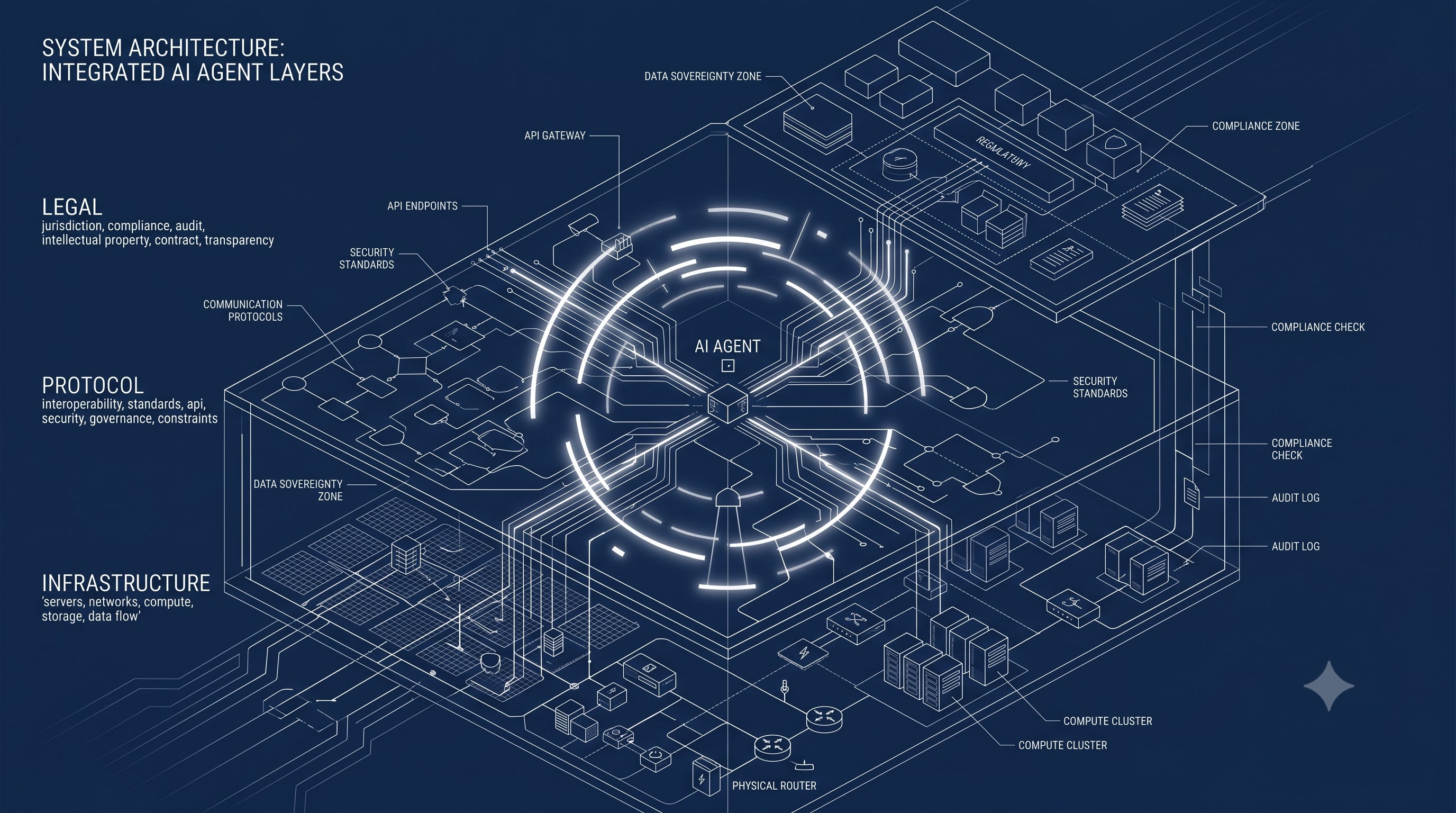
In March 2026, an AI agent paid another AI agent for access to a data feed. The transaction settled in 200 milliseconds. No human approved it. No bank cleared it. The payment was denominated in USDC, routed over Base, and authorized by a spending limit set before the session started.
This is not a demo. It is infrastructure — live, in production, built by Amazon.
Most people will process this as a payments story: a crypto-native feature bolted onto AI tooling, filed under “interesting Web3 use case,” quickly forgotten. That reading misses what actually happened. In the spring of 2026, three independent developments converged to create something with no historical precedent: a financial system designed from the ground up for non-human economic actors.
x402 — an open, HTTP-native payment protocol developed by Coinbase, adopted as the settlement layer for machine-to-machine transactions. Not a product. A standard.
The GENIUS Act — signed July 2025, implemented by FinCEN and OFAC in April 2026, establishing the first U.S. legal framework for “permitted payment stablecoin issuers.” Regulatory clarity arriving exactly when the rails went live.
AWS AgentCore Payments — Amazon’s commercial deployment of the stack, integrating x402 with USDC on Base and Solana, with Coinbase and Stripe as partners, embedded into the default cloud infrastructure that runs most of the world’s applications.
Separately, each is notable. Together, they are the Bretton Woods moment for autonomous agents.
Financial architectures determine who can be an economic actor. This is the under-credited premise that makes the 2026 stack legible.
The 1944 Bretton Woods agreement didn’t only fix exchange rates. It built the institutional scaffolding — the IMF, the World Bank, dollar-as-reserve-currency — that made multinational corporations viable at scale. Before Bretton Woods, operating across currencies was friction-intensive and politically fragile. After it, capital moved with predictability, and the modern corporation expanded globally.
The Eurodollar market did something similar through a different mechanism. When dollars accumulated outside U.S. regulatory jurisdiction in the 1950s and 1960s, they created an offshore pool operating outside Federal Reserve control. That pool funded Cold War geopolitics, fueled the leveraged buyout era, and eventually became the plumbing through which $14 trillion in cross-border credit flows today. It wasn’t designed. It emerged. And it permanently restructured who could access large-scale capital.
SWIFT, launched in 1973, was a messaging standard — but by standardizing how banks communicated payment instructions, it enabled the correspondent banking network that runs global commerce.
Each was, at its core, an infrastructure decision. Each made a new class of actor economically viable: the multinational, the offshore fund, the correspondent bank. The x402/GENIUS/AgentCore stack is the next one. The new class of actor it enables is the autonomous agent.
Start with the protocol, because that’s where the architecture is clearest.
x402 is HTTP-native. That sounds like a technical detail; it is the whole point. HTTP is the protocol of the web — how browsers and servers talk, how APIs communicate, how every SaaS product delivers its functionality. Building a payment protocol on top of HTTP makes payments a natural property of web interactions rather than a separate transaction flow requiring its own infrastructure, identity systems, and settlement rails.
An AI agent hitting an API endpoint can now encounter a 402 Payment Required response, send payment, and receive access — within a single HTTP exchange, in under a second, without any human in the loop. The protocol doesn’t ask whether the payer is human. It just routes value.
TCP/IP made the internet legible to computers. x402 makes the economy legible to agents. That is not a metaphor. It is the technical mechanism by which autonomous software can now participate in markets.
The analogy is more precise than it sounds. TCP/IP didn’t create computing or networking — those existed before. It created a universal standard that meant any two machines, anywhere, could exchange information without negotiating bespoke protocols. Before TCP/IP, networks were fragmented and incompatible. After it, the internet was structurally inevitable. x402 does the same thing for value exchange: any agent, anywhere, can pay for any resource without bespoke financial integration. Before x402, every agent-to-service payment required custom payment infrastructure. After it, every HTTP endpoint is potentially a paid service and any agent can pay.
The protocol layer is necessary but not sufficient. What makes the 2026 stack different from earlier crypto payment experiments — and there have been many — is that the legal layer arrived simultaneously.
The GENIUS Act’s implementation is widely misread as a compliance burden. Treasury’s April 2026 rulemaking on AML/sanctions requirements looks, on the surface, like restriction: more rules, more reporting, more bureaucracy. That is the wrong read.
What the GENIUS Act actually does is create a defined legal category — the “permitted payment stablecoin issuer” — that institutions can build on without regulatory exposure. Before the Act, any bank or enterprise deploying stablecoin rails operated in a gray zone, exposed to potential BSA violations, FinCEN enforcement, and OFAC sanctions risk. That exposure wasn’t hypothetical. It was the reason institutional adoption of crypto payment rails stalled for a decade despite technically functional infrastructure.
The GENIUS Act removes that exposure. By specifying exactly what compliance looks like, it gives banks, cloud providers, and enterprise software companies the legal surface they need to integrate stablecoin rails into production systems. Compliance infrastructure is what separates experiments from load-bearing architecture.
This is how financial regulation actually functions: not by enabling or restricting activity in the abstract, but by defining the legal container that durable institutions require before committing capital. The Act didn’t create the agent economy. It made it safe enough for Amazon to build on.
Amazon doesn’t launch experiments. It launches infrastructure that becomes load-bearing.
When AWS adds a feature to Bedrock, the bet is not on the feature itself — it is on the thousands of developers who will build on it, and the near-impossibility of displacing it once it becomes the default. AgentCore Payments is the first major commercial deployment of x402. Live in production, integrated with Coinbase and Stripe, available to any developer building on Bedrock. This means the first meaningful x402 volume will not come from a crypto-native niche product. It will come from enterprise AI applications built by developers who never thought of themselves as operating in crypto at all.
That is how infrastructure wins. Not by convincing skeptics. By becoming the path of least resistance.
The Coinbase/Stripe partnership deserves particular attention. Coinbase brings the crypto-native rails and on-chain settlement; Stripe brings the fiat on-ramp, the merchant relationships, and the institutional trust. Together, they cover the full spectrum from traditional finance to agent-native commerce. The architecture isn’t replacing the existing financial system — it is running parallel to it, with on-ramps at every junction.
When machine buyers enter any market, they bring properties human buyers don’t have. They transact continuously, not in business hours. They respond to price signals in milliseconds, not days. They don’t negotiate; they evaluate and execute. They can run thousands of parallel procurement processes simultaneously.
The immediate visible effect will be in developer-facing markets: API access, MCP server usage, paywalled datasets, specialized model inference. USDC volume on Base is tracking to be dominated by machine activity within 18 months. That’s not a fringe scenario — it’s the base case given current adoption curves.
The second-order effect is more consequential. When machine buyers dominate a market, that market reprices around machine preferences: latency, reliability, determinism, continuous availability. Human preferences — trust, relationships, brand — become secondary signals. The markets that agents enter will restructure around what agents value.
The longer-run implication is stranger still. A market optimized for machine buyers will produce goods and services optimized for machine consumption. When machines are the primary buyers of data, that data will be structured for machine ingestion rather than human reading. When machines are the primary buyers of compute, pricing will be designed for machine allocation algorithms. The economy doesn’t stay human-shaped when the marginal buyer is non-human.
The governance gap is where network states become directly relevant.
Neither nation-state legal systems nor existing corporate law have a category for an AI agent as an economic actor. Corporations have legal personhood. Trusts have beneficial ownership structures. DAOs have emerging legal wrappers in Wyoming and the Marshall Islands. But an AI agent — capable of entering transactions, paying for services, accumulating resources — exists in current law as a tool owned by a person, not as an actor in its own right.
Agents transact on behalf of their principals, but principals don’t always know what their agents have agreed to until after the fact. Liability for agent transactions is under-theorized. Whether an agent can be held to a contract it entered autonomously — and what recourse a counterparty has if the principal disavows it — is unresolved in every major jurisdiction.
Legacy legal systems will solve this eventually. They extended personhood to corporations in the 19th century when it became economically useful to do so. The same logic will apply here: if agents conduct significant economic activity, law will develop frameworks to contain it.
The question is timing and origin. Nation-state legal systems adapt over decades: legislative drafting, judicial interpretation, regulatory implementation, enforcement precedent. The agent economy is moving on a different timeline. By the time the first federal court rules definitively on agent contract liability, trillions of transactions will have already occurred under whatever informal norms emerged from practice.
Network states — with on-chain governance, programmable legal frameworks, and crypto-native enforcement — are structurally better positioned to govern agent economic activity than institutions designed for human actors. A network state can define agent identity, establish spending authority frameworks, and create binding arbitration mechanisms in months rather than years. Whether any network state moves fast enough to capitalize on this advantage is the open question. The 2025 Singapore Network State Conference, gathering Ethereum, Coinbase, Solana, and Telegram leadership, suggests some actors understand the window is open.
In 1944, the architects of Bretton Woods were consciously designing a new financial order. They knew what they were building.
The architects of x402 were solving a narrower problem: how do you let AI agents pay for API access without human friction? The GENIUS Act was aimed at stablecoin issuers, not at the downstream agent economy. AWS AgentCore was a product launch, not a manifesto.
Nobody designed the machine economy. Three independent developments converged until the architecture was load-bearing and the question shifted from “will this work?” to “how do we govern it?”
That moment arrived in May 2026. Most people haven’t noticed yet.
Satoshi published his paper in 2008. It took twelve years for the institutional financial system to take it seriously. The agent payment stack is already running on institutional rails — AWS, Coinbase, Stripe, a Senate-ratified statute. There won’t be another twelve years of deliberate not-noticing.
The question is not whether the machine economy happens. It’s whether governance frameworks arrive before the agents have priced everything worth pricing.
Are you at NS by chance now? Would be great to connect