


Let’s get the eye-roll out of the way: “AI agents paying each other in crypto” sounds like two hype cycles in a trench coat. A lot of it is.
But underneath the noise, something real got built over the last year. Coinbase, Google, Stripe, Visa, Mastercard, Circle, and Anthropic have all shipped pieces of an agent-payment stack — and the numbers are simultaneously bigger and smaller than you’ve been told. Bigger, because the raw transaction counts are genuinely enormous. Smaller, because most of that volume is testing and wash trades, not real commerce.
This guide is written for people who want to build something here, or land a job doing it. So at each step the question isn’t just “what is this?” but “if I’m building, what does this mean for me — and is this lane crowded or wide open?” Every claim is sourced at the bottom. The dated figures are mid-2026 snapshots; treat them as a moment in a fast-moving story, not gospel.
Here’s the one number that frames everything:
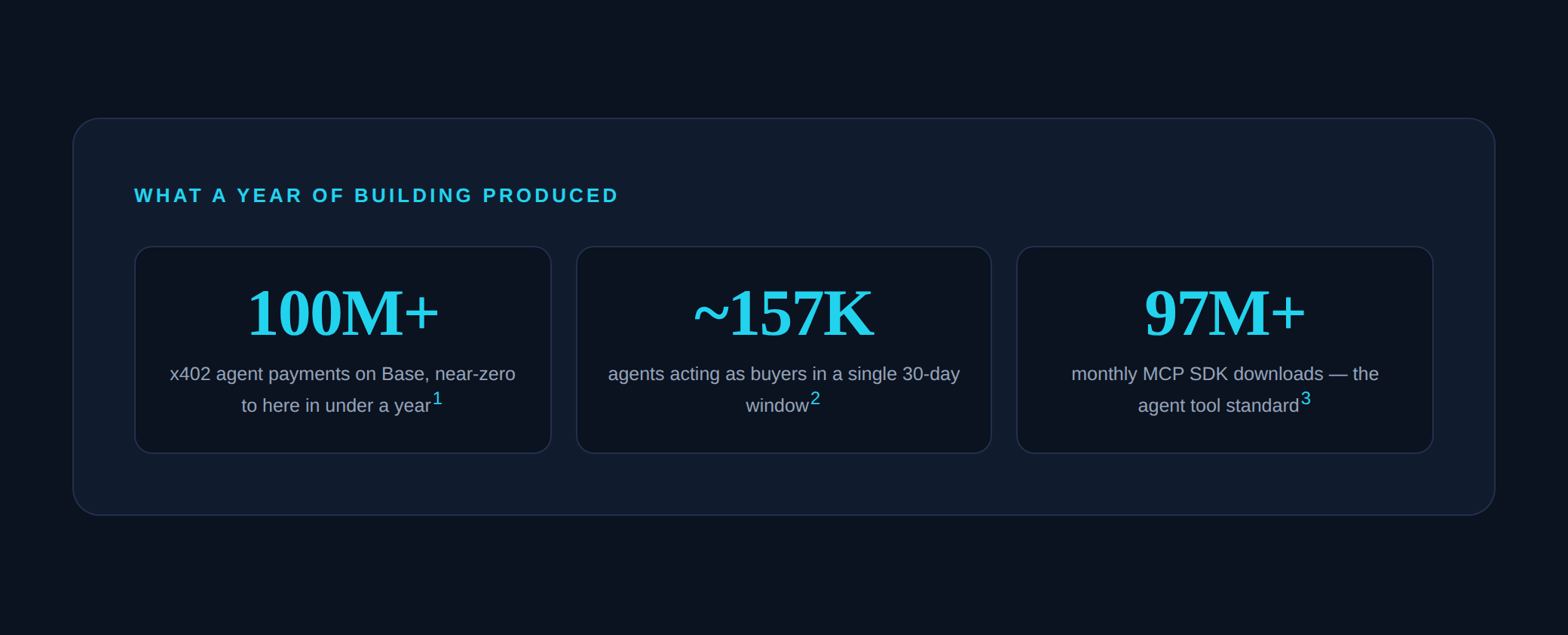
Hold those numbers. By the end you'll know which ones to trust, which to discount, and where the actual openings are.
Why the card rails break for machines
Start with why crypto is involved at all, because this is the part people skip — and it’s the whole reason the rest exists.
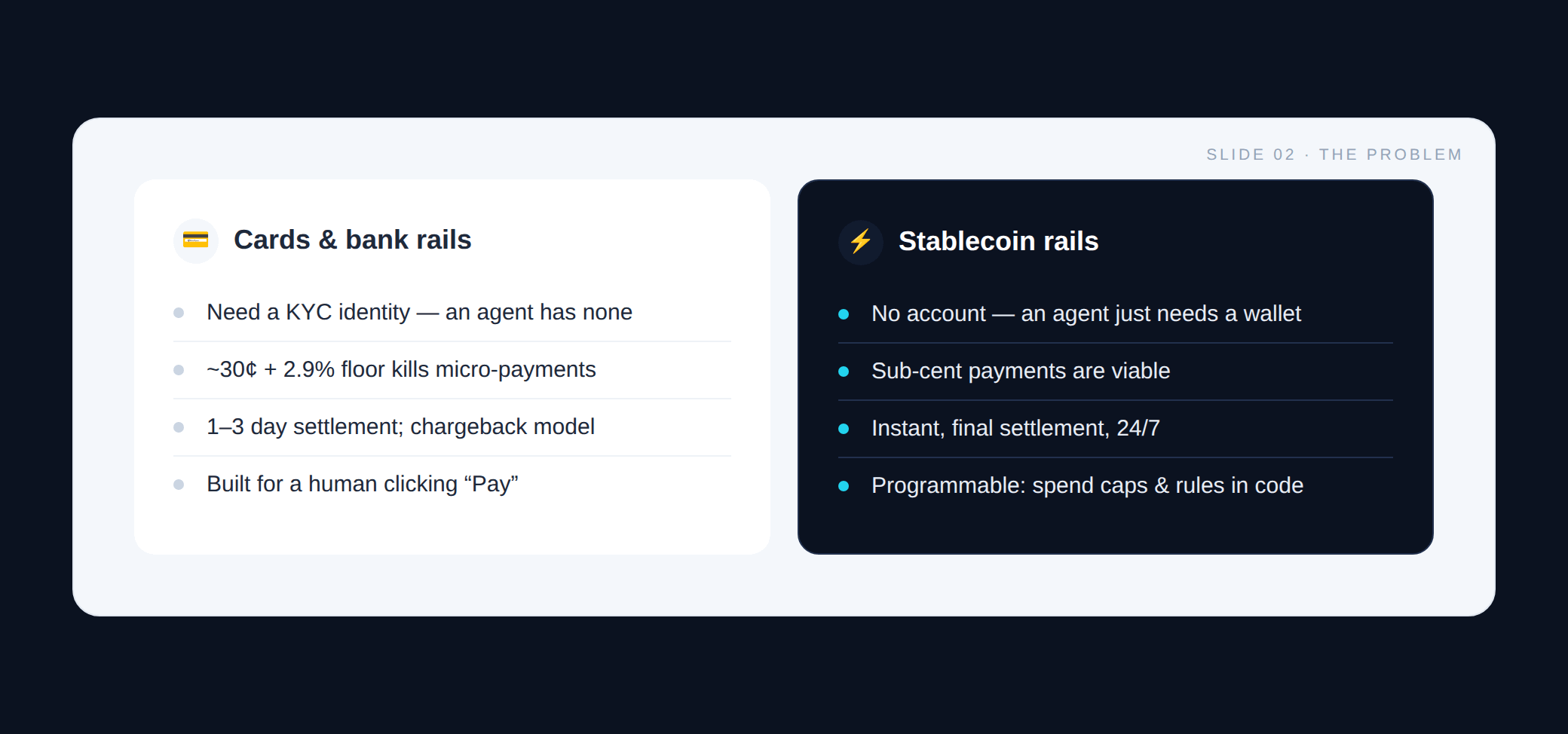
An autonomous agent doing real work calls services it has never used before, potentially thousands of times an hour, often for fractions of a cent each. Drop the human payment stack into that world and it falls apart immediately. Cards need an account and a KYC identity — an agent has neither. The ~30¢ + 2.9% fee floor makes a sub-cent payment economically absurd. Settlement takes days; chargebacks assume a human dispute process. Cards were built for a person clicking “Pay,” not software transacting at machine speed.
Stablecoins happen to solve exactly these constraints. No account — just a wallet. Sub-cent payments that actually clear. Instant, final settlement, around the clock. And critically for agents: the rules can live in code — spend caps, allowlists, per-task budgets.
This is why a16z frames it the way they do: for every human in financial services, agents may eventually outnumber them by roughly 100 to 1, and at that scale payments have to vanish into the network — no checkout page, no human in the loop. Coinbase's Brian Armstrong put it more bluntly: agents can't open a bank account, but they can own a crypto wallet.
If you're building: The opportunity here isn't "make a new stablecoin." It's everything that assumes agents can pay: metered APIs, pay-per-call data, compute you rent by the second. If your product currently needs a human to enter a card, there's a version of it that an agent can use unattended — and almost nobody has built that version yet.
The four-layer stack
Before the specific projects, here’s the map to keep oriented. The agentic crypto world is a stack of four layers, each answering a different question an autonomous agent has to resolve before it can do anything useful and pay for it.
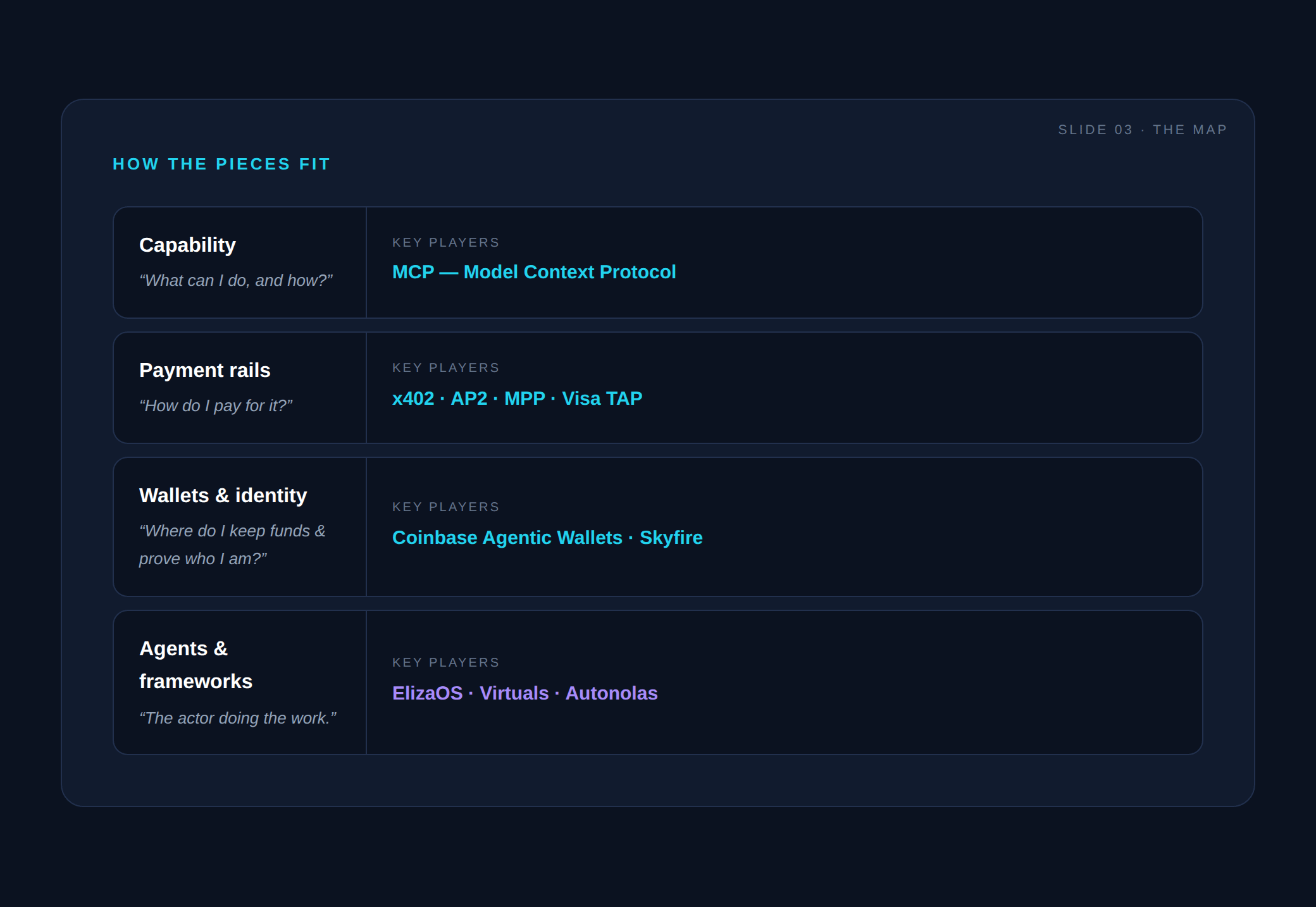
Most of the genuine action — and most of the real builder opportunity — sits in the middle two layers: the rails and the wallets. The top layer (capability) is being standardized fast by Anthropic's MCP; the bottom layer (frameworks) is crowded and largely speculative. We'll take the interesting layers one at a time.
x402: paying over plain HTTP
If you learn one thing from this guide, make it x402. It’s the most concrete, most explainable, and most-adopted piece of the whole story — and it’s built on a joke the web has been sitting on for almost thirty years.
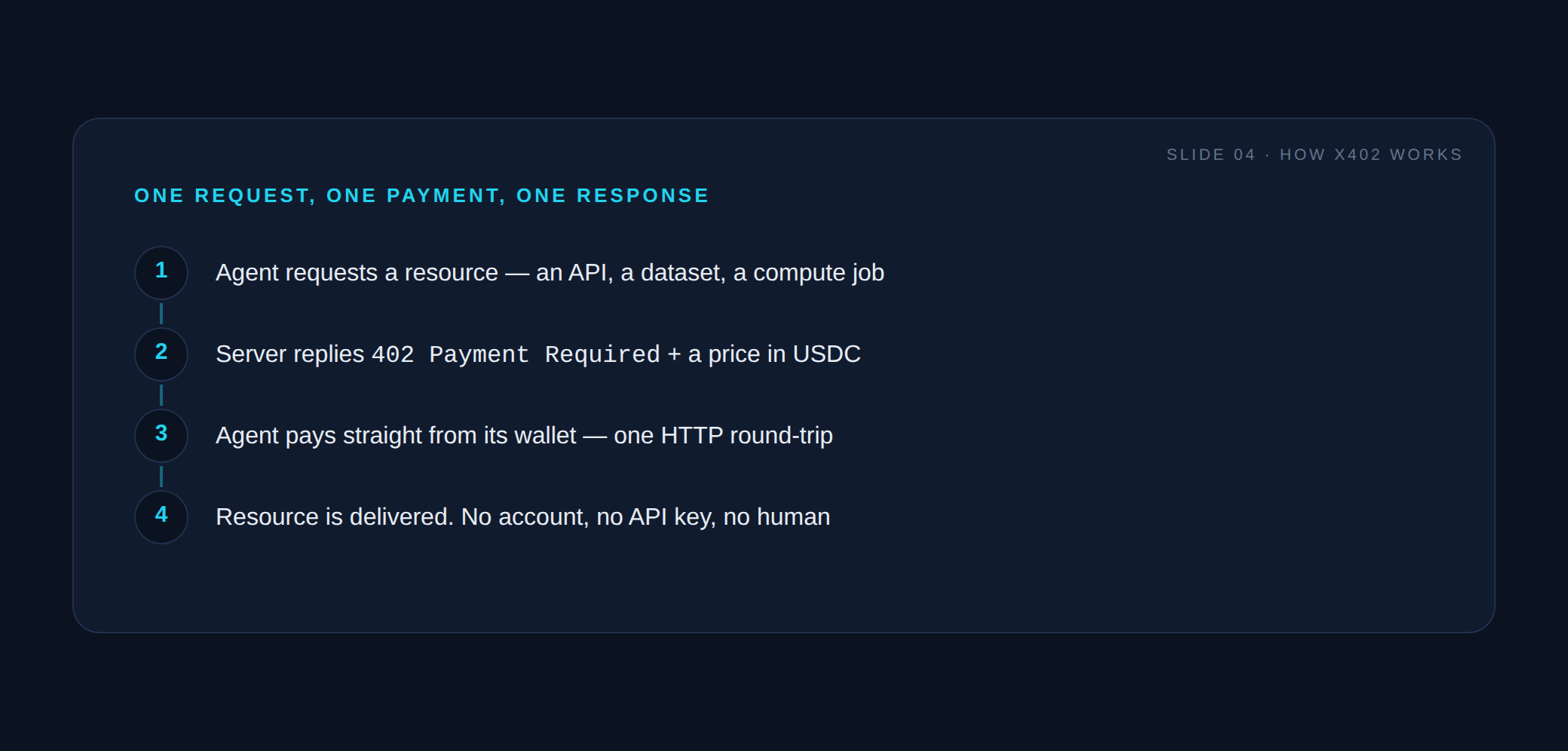
When HTTP was designed, the spec reserved status code 402 Payment Required for future use. It then sat dormant since 1996. x402, launched by Coinbase in May 2025, finally uses it: an agent requests a resource, the server replies 402 with a price, the agent pays in USDC from its wallet, and the resource is delivered — all in a single HTTP round-trip, no account or API key required.
Why this caught on where earlier "web payments" ideas didn't: it asks developers to change almost nothing. It rides existing HTTP, settles on fast and cheap chains (Base first, later Solana and Polygon), and was handed to a neutral x402 Foundation co-founded by Coinbase and Cloudflare, with Google, Visa, AWS, Circle, and Anthropic involved. Stripe and Cloudflare Workers added support; Google wired it into its own agent-payment protocol. That's an unusual amount of heavyweight alignment for something barely a year old.
If you're building: This is the most approachable on-ramp in the space. Putting an x402 paywall in front of an API is close to a weekend project, and the tooling (AgentKit, the x402 SDK) is real and documented. The wide-open question nobody's answered yet: what's actually worth selling to an agent for a fraction of a cent? Whoever figures out the killer pay-per-call service — not the protocol, the thing being sold — captures the first real demand.
How an agent holds money without disaster
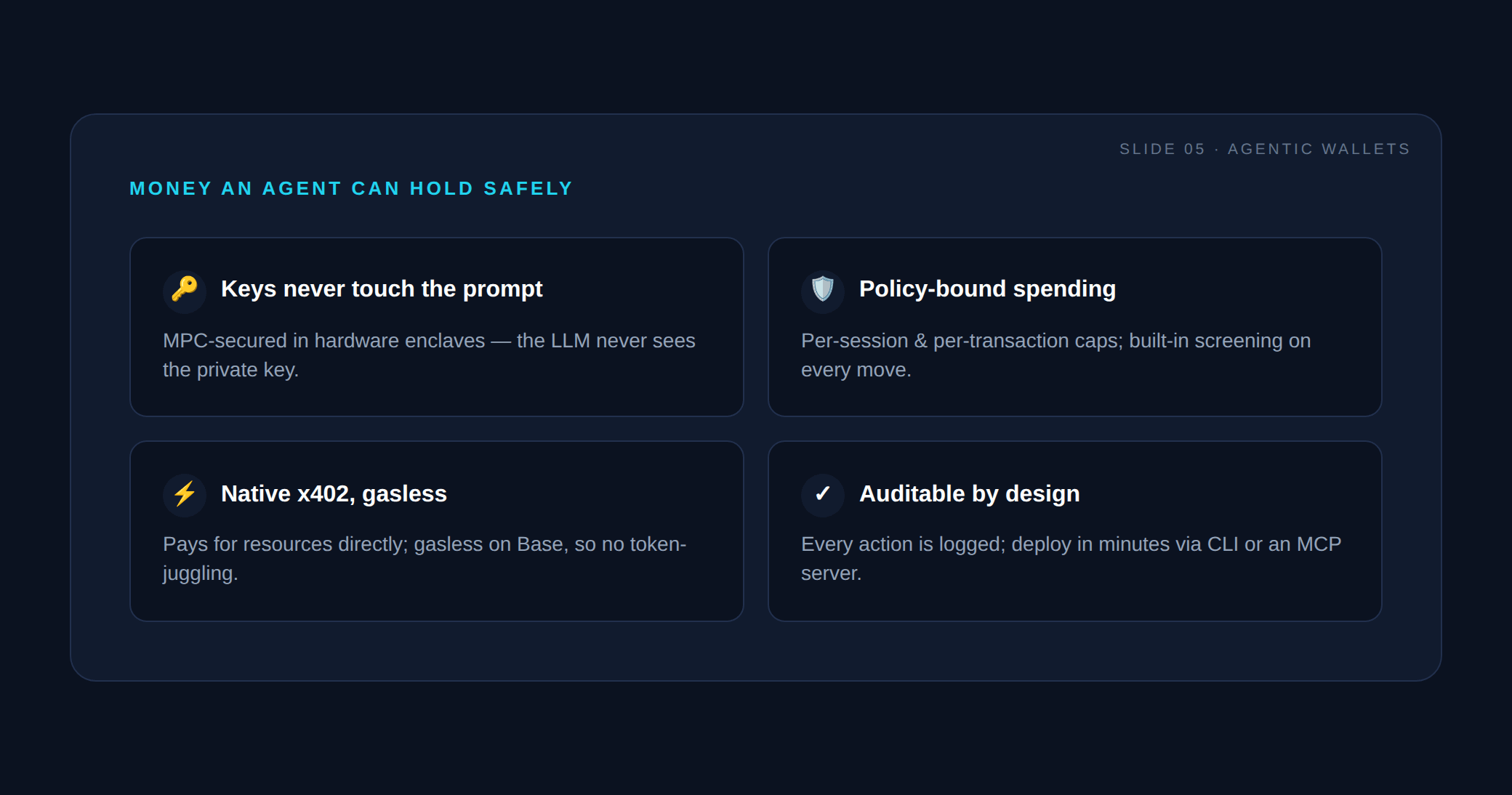
There’s an obvious objection to all of this: giving an autonomous LLM control of a wallet sounds like handing your car keys to a very confident toddler. The thing that makes it workable is wallet infrastructure built specifically for agents — and the clearest example is Coinbase Agentic Wallets, launched February 2026.
The core design principle: the model never sees the keys. Private keys are secured with MPC inside hardware enclaves, and the agent is allowed to act only within policies you set — per-transaction and per-session spend caps, allowlists, built-in transaction screening. The LLM proposes; the policy layer disposes. Every action leaves an audit trail.
Around this sits an emerging identity layer — startups like Skyfire issuing agents verifiable credentials and funding their wallets with controls, the "Know Your Agent" (KYA) idea a16z expects to formalize through 2026. If a payment is happening, someone wants to know which agent, acting for whom, under what authority.
If you're building: Wallets themselves are being commoditized by Coinbase — don't compete there. The open ground is one level up: spend-policy tooling, agent identity and reputation, fraud detection tuned for machine-speed traffic, dashboards that let a human supervise a fleet of spending agents. The security and trust layer for the agent economy is barely sketched in.
MCP: how agents find and use tools
Payments only matter if an agent can find the thing to pay for. That’s the job of Anthropic’s Model Context Protocol — think of it as the USB-C of AI tools: a standard way for an agent to ask any service “what can you do, and how do I call it?” It’s spread remarkably fast, and in December 2025 it was donated to the Linux Foundation’s new Agentic AI Foundation, putting a neutral body in charge.
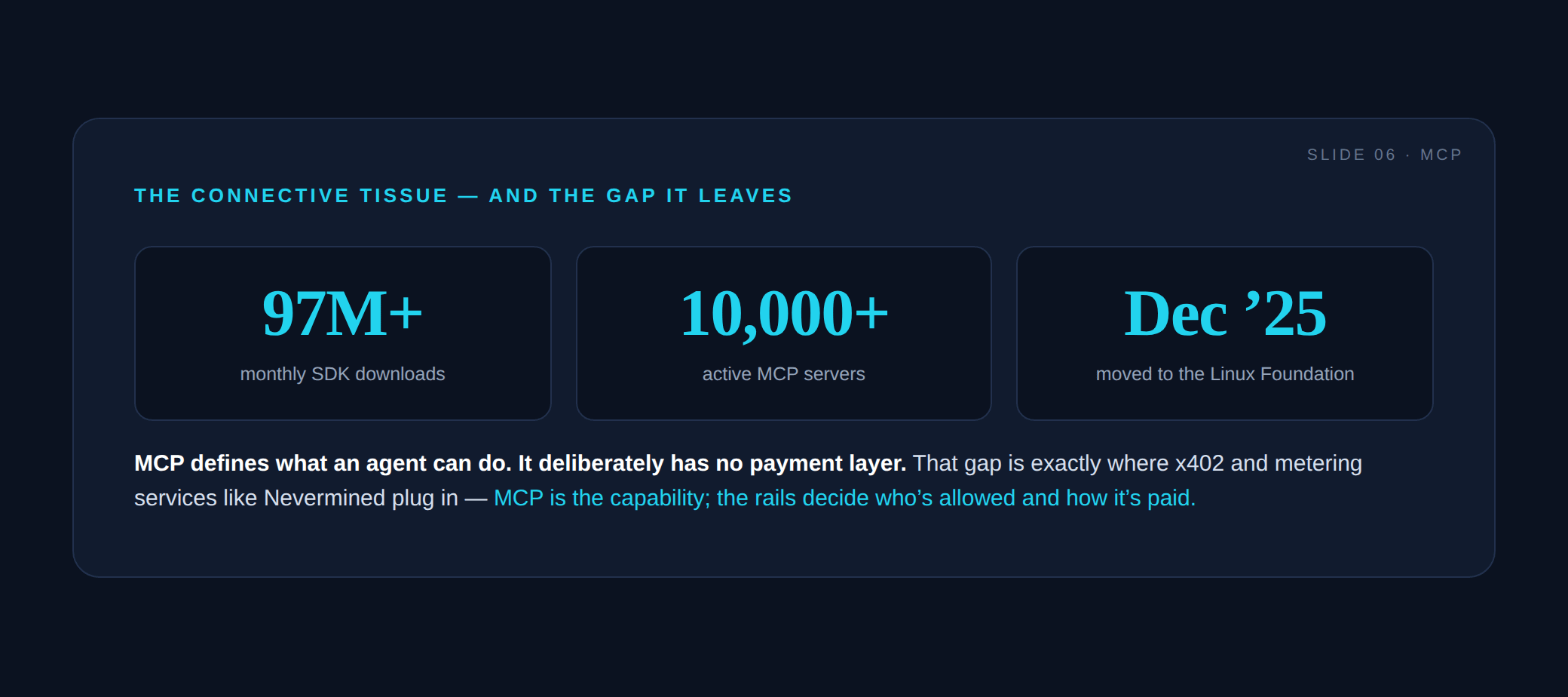
This split is the single most useful mental model in the guide. MCP turns a chatbot into something that can reach the world; payment rails turn it into something that can transact with the world. Put them together and you have an agent that can discover a service, call it, and pay for it with no human babysitting the loop.
If you're building: Shipping an MCP server for your product is fast becoming table stakes — it's how agents will discover you at all. The sharper play is an MCP server that's also monetized via x402: your capability and your pricing exposed in one place, agent-ready. Very few services have done both yet.
The fight to be the payment standard
Here’s where it gets political. x402 has the early lead, but it is not alone — Big Tech and the card networks all want to own how agents pay. The honest builder’s stance: don’t marry one standard yet. Know the field, and design so you can settle across more than one.
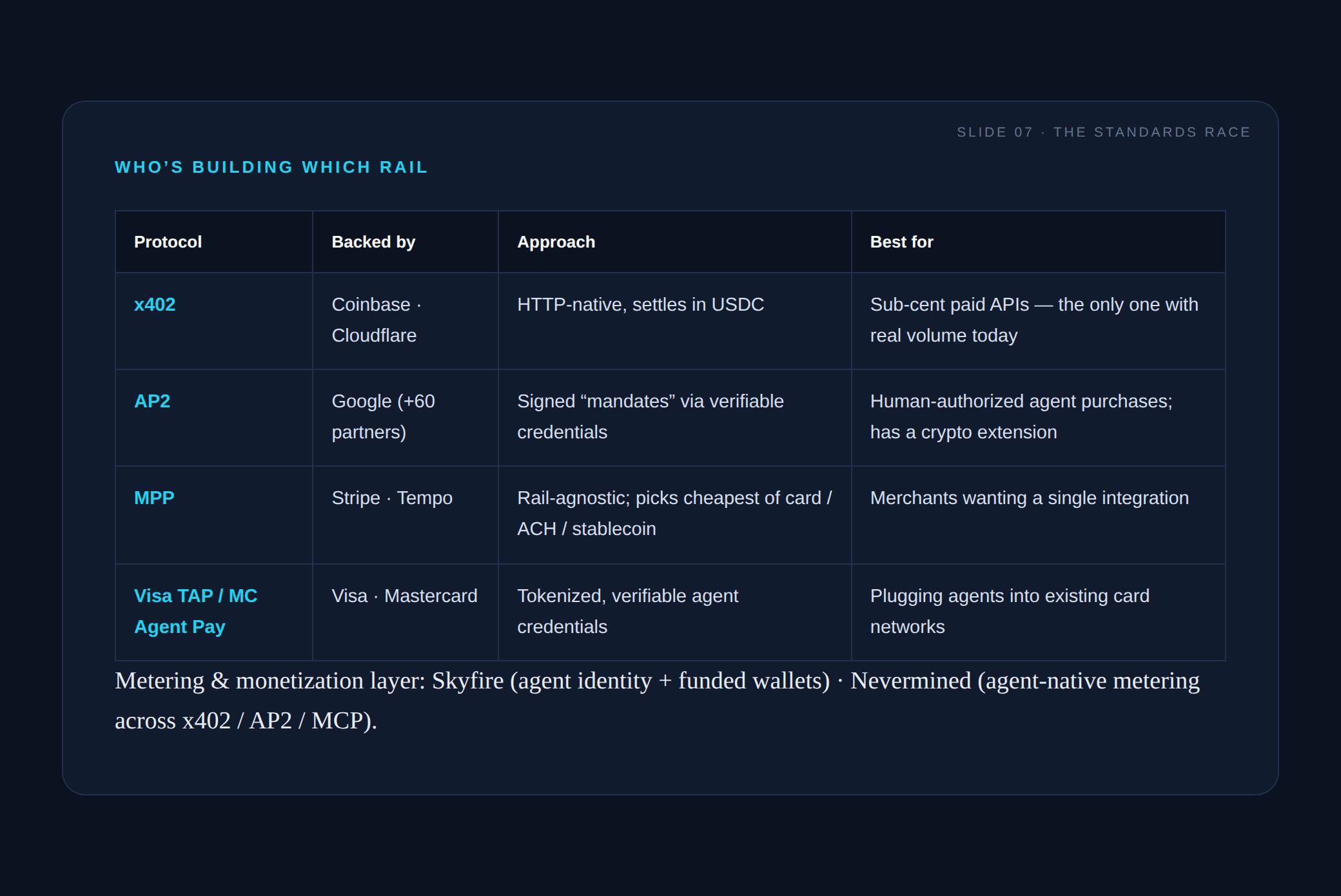
Metering & monetization layer: Skyfire (agent identity + funded wallets) · Nevermined (agent-native metering across x402 / AP2 / MCP).
Note these aren’t all competitors in the same lane. x402 is best at tiny machine-to-machine payments; Google’s AP2 is built around human-authorized purchases an agent executes on your behalf; Stripe’s MPP is rail-agnostic and will happily route over a card if that’s cheapest; the card networks want agents to ride the rails that already exist. The likely outcome isn’t one winner but a few standards that interoperate — which is exactly why the metering layer that sits above all of them is interesting.
If you're building: Betting your whole product on one protocol is the risk. Building across them — abstraction layers, routing, "accept any agent payment" tooling — is the hedge that also happens to be a real product. This is the bet several well-funded teams are already making; it's contested ground, not empty, but it's where the durable infrastructure value likely accrues.
Now the part nobody puts on a slide
Remember those 100M+ transactions? Here’s the uncomfortable footnote. When a16z’s team stripped out the testing and wash trades, real agent-payment volume came to roughly $1.6M a month as of early 2026. Chainalysis traced much of the early surge to a meme-coin “pay-to-mint” loop that did exactly what crypto incentive loops always do — generated enormous transaction counts and very little real economic activity. And most of the AI-agent tokens minted in the 2024–25 frenzy now trade 55–90% below their highs.
So is it all noise? No — and the distinction is what separates a useful builder from a bag-holder.
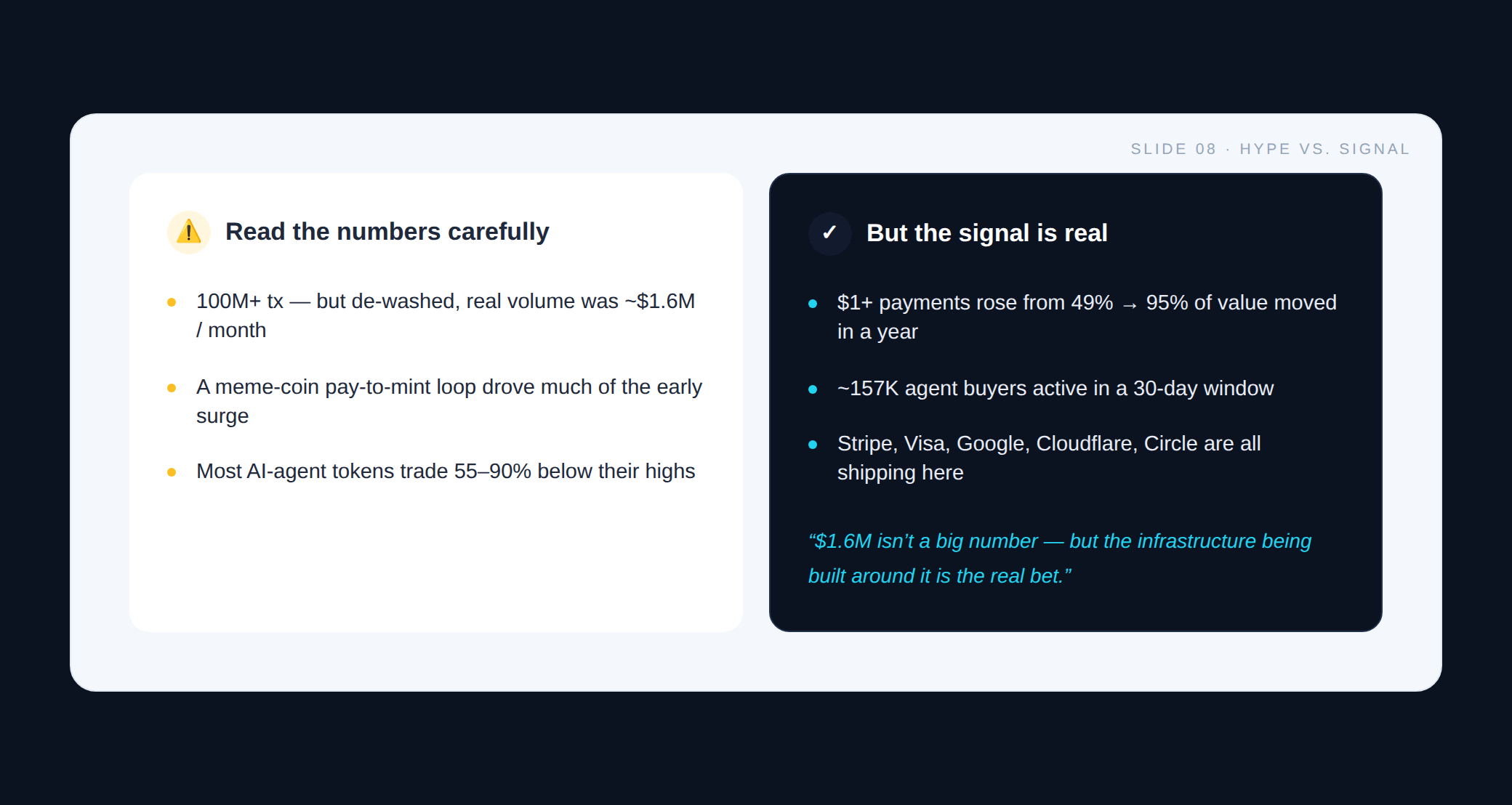
The tell is the trend line: payments over a dollar went from about half of value moved to nearly all of it across the year. That's what real usage creeping in looks like — the micro-spam shrinks as a share, actual transactions grow. The infrastructure is genuinely real and genuinely early. The tokens are mostly a casino. Build on the first; don't gamble on the second.
The signals that tell you it’s working
This is a field guide, so here’s the field. These are the things actually worth tracking over the next year — the leading indicators that tell you whether the agent economy is becoming real or staying a demo.
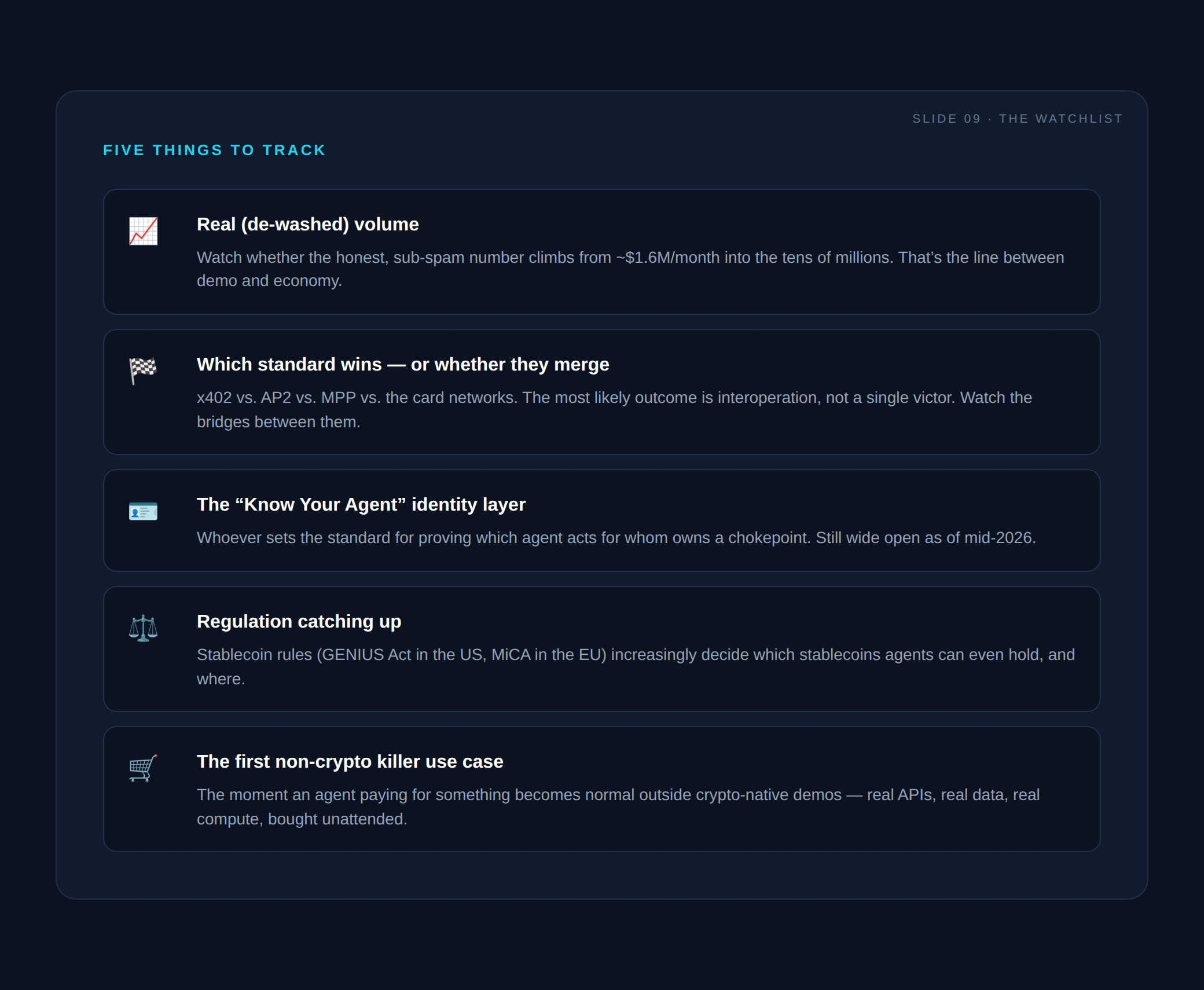
Build now, while it’s still early and weird
Strip away the token charts and here’s what’s left: a new kind of buyer is coming online — software that can’t bank but can hold a wallet — and the rails for it are being laid right now by the most serious companies in tech and finance. The volume is small. The tokens are mostly noise. The infrastructure is real, and it’s early enough that a single builder can still matter.
That combination — real foundation, tiny current usage, heavyweight backing — is the most interesting moment to enter anything. You’re not late. You’re early enough that the obvious things haven’t been built yet. Pick a layer, ship something small, and learn the stack before agents become the default buyer instead of the novelty.
Where to look next
If you want to go from reading to building, these are the on-ramps worth your weekend: Coinbase AgentKit docs · x402 protocol & docs · x402scan (live endpoints) · MCP specification · DeFiLlama (data) · ETHGlobal (hackathons).
Sources & notes
Chainalysis, “Inside x402: 100M Agentic Payments on Base” — cumulative transaction counts, the PING meme-coin pay-to-mint loop, and the shift toward $1+ payments.
CNBC, “Coinbase launches tool to let AI agents manage trading and payments” (Jun 2026) — ~157,000 agent buyers active in a 30-day window.
Anthropic / Model Context Protocol, “MCP joins the Agentic AI Foundation” (Dec 2025) — 97M+ monthly SDK downloads, 10,000+ active servers, Linux Foundation donation.
a16z — framing on agents outnumbering human users in finance and the emerging “Know Your Agent” identity layer. (Verify primary source before publishing.)
Brian Armstrong (Coinbase CEO), public remarks, March 2026 — agents can’t open bank accounts but can own crypto wallets.
Coinbase Developer Platform, “Introducing Agentic Wallets” (Feb 2026) — MPC security, policy-bound spending, native x402.
a16z (via reporting, Mar 2026) — de-washed real agent-payment volume of roughly $1.6M/month. (Verify primary source before publishing.)
All figures are mid-2026 snapshots in a fast-moving, volatile space. Several adoption metrics originate from vendor sources (Coinbase, Nevermined, Virtuals) and should be cross-checked against neutral analytics. Nothing here is investment advice.